Ch 1 A Square and a Cube
Films in this chapter
-
 8:35
Film
Perfect Squares: The 100 Lockers Puzzle
- Coming soon Story Cubes and Ramanujan's Number 1729
- Coming soon One shot A Square and a Cube One Shot
In this chapter
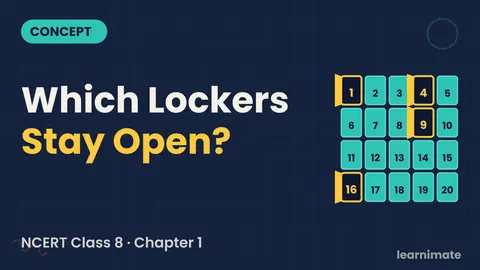
In this chapter. The first chapter of the Class 8 Ganita Prakash book starts with a puzzle dressed up as a queen's will: a hundred lockers are opened and closed by a long line of people, and only some stay open at the end. Working out which ones leads straight to square numbers, because a locker's fate depends on how many factors its number has, and factors pair up except for the middle one of a square.
From there the chapter builds a toolkit for squares. It looks at the last digits a square can and cannot have, at square numbers as sums of consecutive odd numbers, and at how many non-squares sit between one square and the next. Prime factorisation gives a reliable test: a number is a perfect square when its prime factors split into two identical groups. The chapter then turns the question round and finds square roots, by subtracting odd numbers, by factorising, and by estimating between known squares.
The second part does the same for cubes. Unit cubes stacked into bigger cubes give the perfect cubes , and grouping prime factors in threes tells you whether a number is a cube and what its cube root is. Along the way you meet 1729, the smallest number that is a sum of two cubes in two different ways, known as a taxicab number.
A short history section closes the chapter, tracing tables of squares and cubes back to ancient times and to the terms early Indian mathematicians used for them.
The concept film for this chapter so far explains the locker puzzle itself: why every locker that stays open has a perfect-square number, plus quick ways to spot a square and count the numbers between squares.