Ch 2 Polynomials
Films in this chapter
-
 8:39
Concept film
Zeros of a Polynomial on a Graph
- Coming soon One shot Polynomials One Shot
In this chapter
This chapter of the NCERT Class 10 book picks up polynomials from Class 9 and asks what their zeroes look like and how they connect to the coefficients. It starts by recalling the degree of a polynomial and the names for degree one, two and three: linear, quadratic and cubic.
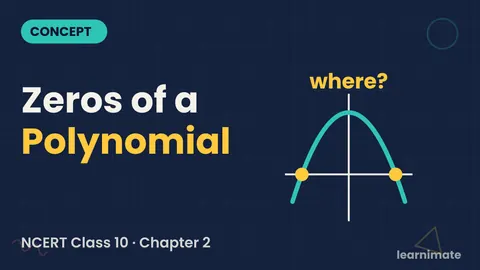
The first big idea is geometric. A zero of a polynomial is a value of that makes it equal to zero, and on a graph that is exactly where the curve meets the -axis. A straight line meets the axis once, so a linear polynomial has one zero. A parabola can cross the axis twice, touch it once, or miss it completely, so a quadratic has two, one or no zeroes. A cubic can meet the axis up to three times. The general rule is that a polynomial of degree has at most zeroes, and the chapter's graph exercises train you to count them by eye: count meetings with the axis, not bumps.
The second idea is algebraic. For a quadratic , the two zeroes always add to and multiply to . That lets you check zeroes you have found by factorising, predict where zeroes lie before solving, and run the process backwards to build a quadratic when only the sum and product of its zeroes are given.
Board questions on this chapter usually ask you to find the zeroes of a quadratic and verify these two relationships, to read the number of zeroes off a graph, or to write a quadratic polynomial from a given sum and product.