The idea
Picture the parabola . It meets the -axis at and . Now lift the whole curve slowly upward. The two meeting points drift towards each other, merge at , and then disappear as the curve rises clear of the axis. The polynomial is still there, but it no longer has any real zero.
A zero is a crossing. A zero of is a value of that makes equal to . For , putting in gives , and the line cuts the -axis at exactly . That match is no accident: every point on the -axis has , so wherever a graph meets that axis, the polynomial's value is zero. Any line with cuts the axis once, so a linear polynomial has one zero. A constant such as is a flat line that never reaches the axis, so it has none.
Parabolas: two, one or none. factorises as and crosses at and . Change only the constant and you get , which just touches the axis at (one zero, counted twice), and , which floats above it with no zeroes. A negative term turns the valley into a hill, as in with zeroes and , but the same three outcomes apply.
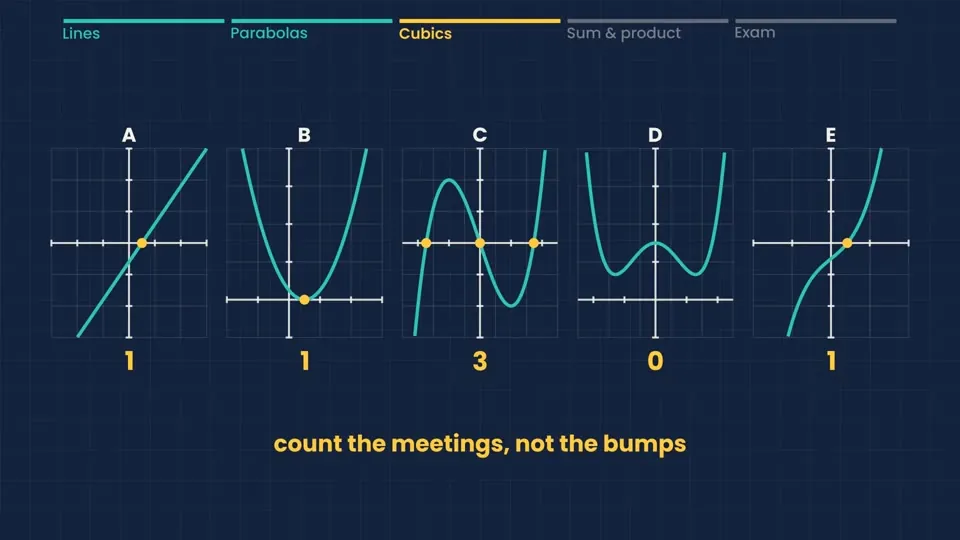
Cubics and the ceiling. snakes across at , and . Yet alone crosses only at , and touches at and crosses at . Because a cubic's two arms head in opposite directions, it must cross somewhere, so it always has at least one zero. The pattern: degree allows at most zeroes, and the graph tells you how many you really get.
Reading any graph. To count zeroes from a picture, count the points where the curve meets the axis. Crossings count, touches count, and a curve that bends near the axis but turns away does not.
Sum and product. The zeroes of add to and multiply to . The product is the constant term; the sum is the middle coefficient with its sign reversed. Slide that middle coefficient to and the zeroes become awkward decimals, yet they still add to and multiply to . In general, for with zeroes and , the sum is and the product is . Expanding shows why. These signs locate the zeroes before you solve: a negative product puts one zero on each side of the origin, while a positive sum and product, as in , put both on the right, at and .
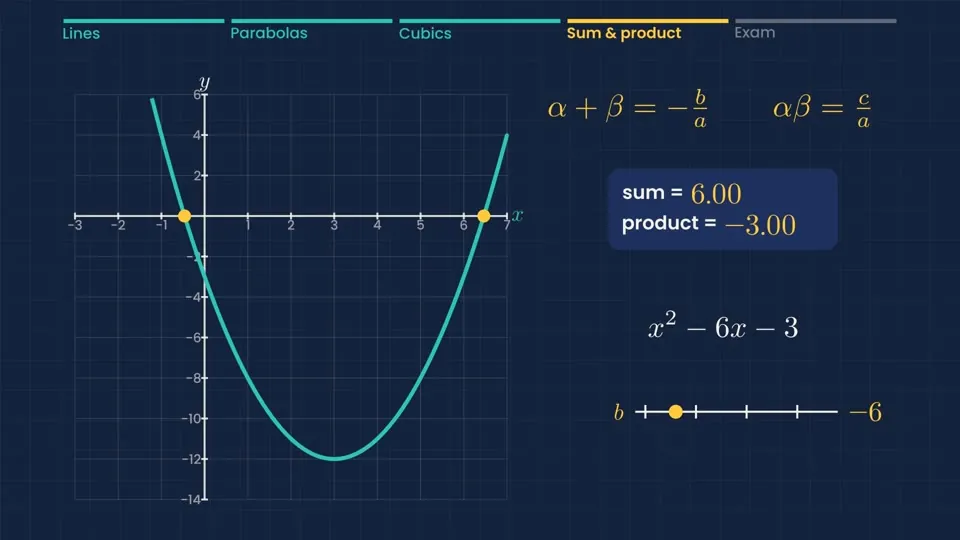
Working backwards. For zeroes and , the sum is and the product is , so gives . Stretching or flipping it leaves the crossings where they are.
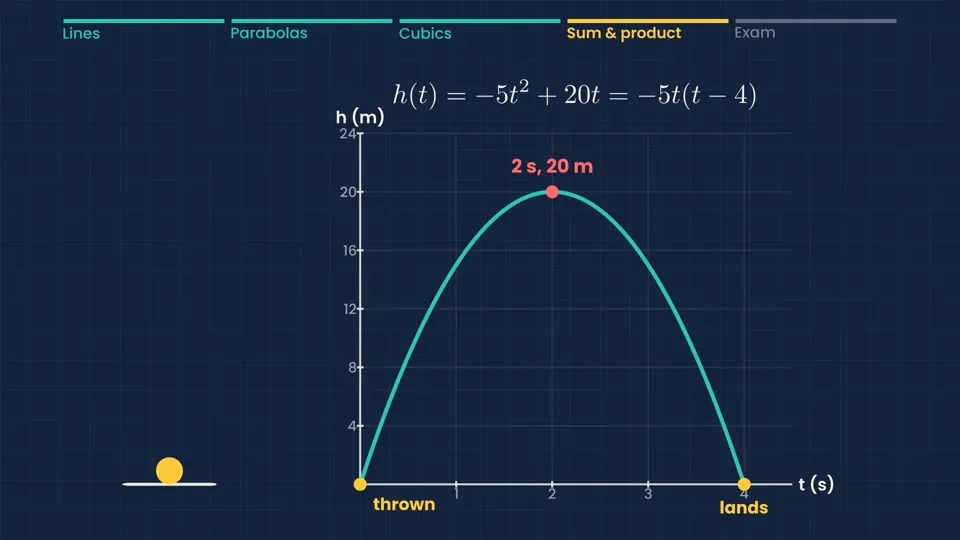
Zeroes with a meaning. A ball thrown upward at 20 m/s has height roughly . Its zeroes, and , are the moments it leaves your hand and lands; halfway, at 2 seconds, it peaks at 20 m.
Key formulas
teal what we're studying · yellow what's changing · coral a common slip
Common mistake
Counting the bumps instead of the meetings. A curve that dips towards the -axis and turns back without touching it has \cor{no zero there}: only points where the graph actually meets the axis count, whether it crosses or just touches.
A second slip is saying "the" quadratic with given zeroes. , and all have zeroes and , so the book asks for a quadratic polynomial.
Exam lens
Find the zeroes of and verify the relationship between the zeroes and the coefficients.
Split the middle term: , so
The zeroes are and . Here , , .
The zeroes are and , and both relationships hold.