Ch 4 Quadratic Equations
Films in this chapter
- Coming soon Visual proof Completing the Square, Visually
-
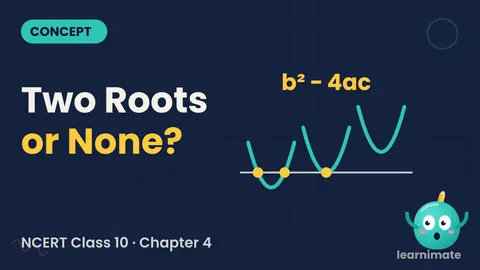 8:34
Concept film
Discriminant and Nature of Roots
- Coming soon Story Quadratic Formula: Sridharacharya's Story
- Coming soon One shot Quadratic Equations One Shot
In this chapter
This chapter of the NCERT Class 10 book moves from straight lines to equations with a squared term. A quadratic equation can be written in the standard form , where is not zero, and the chapter starts by showing how such equations come out of everyday situations, such as a rectangle with a given area or a train that could save time by going faster.
Solving them comes next. When a quadratic splits into two linear factors, setting each factor to zero gives a root. For the rest, the book uses the quadratic formula, which gives both roots straight from , and ; it credits Sridharacharya with deriving it by completing the square. The same formula then shows that the number decides what kind of roots to expect.
The last idea is the nature of the roots. The quantity , called the discriminant, decides whether a quadratic has two different real roots, two equal roots, or no real roots, all before any solving. On a graph this is the question of whether the parabola crosses the -axis twice, just touches it, or misses it entirely. Exam questions often run this backwards and ask for the value of a constant that gives equal roots, or check whether a design such as a garden with a fixed perimeter and area is possible at all.
The concept film published here shows the discriminant on a parabola that slides up and down past the axis. Planned films add completing the square with area tiles and the story behind Sridharacharya's formula.