The idea
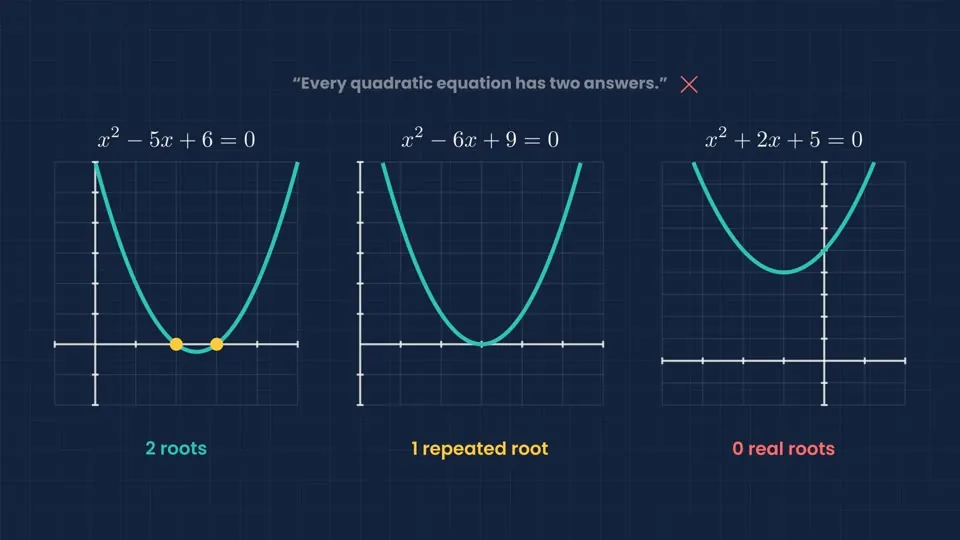
A common belief is that a quadratic always has two answers because it contains . Look at three of them side by side and the belief falls apart: has the roots 2 and 3, has only 3, and has no real root at all. The surprise is that you can tell which case you are in without solving.
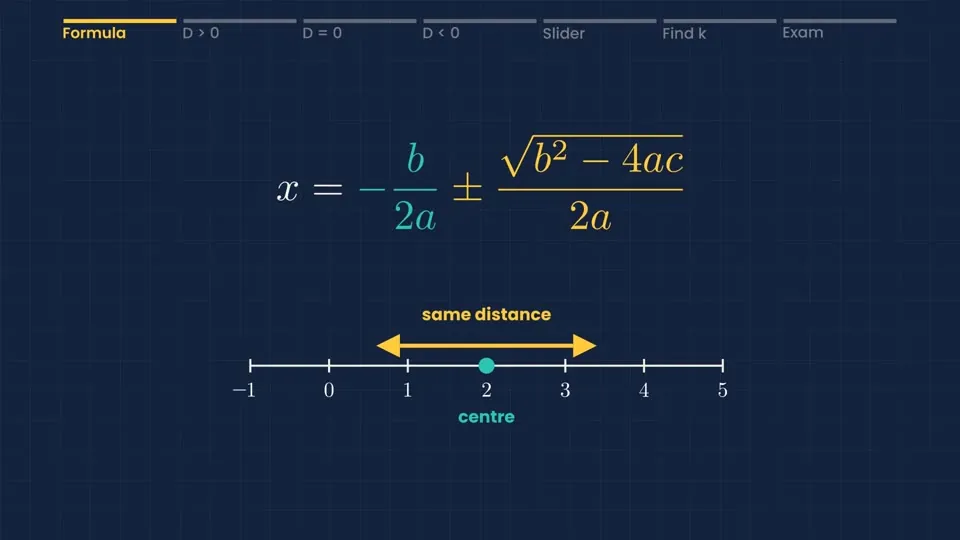
Where the number comes from. Rewrite the quadratic formula as a centre plus or minus a step:
The point is fixed. The two roots sit the same distance to its left and right, and that distance depends on one quantity, . The NCERT book names it the discriminant, , because it separates the cases.
Three cases. If is positive, the step has a real, non-zero length, so you get two different real roots: for , and the roots are half a unit either side of 2.5. If is zero, the step shrinks to nothing and both roots land on the centre; is , the same factor twice. If is negative, you would need the square root of a negative number, which no real number gives, so there are no real roots. Completing the square shows why: can never drop below 4.
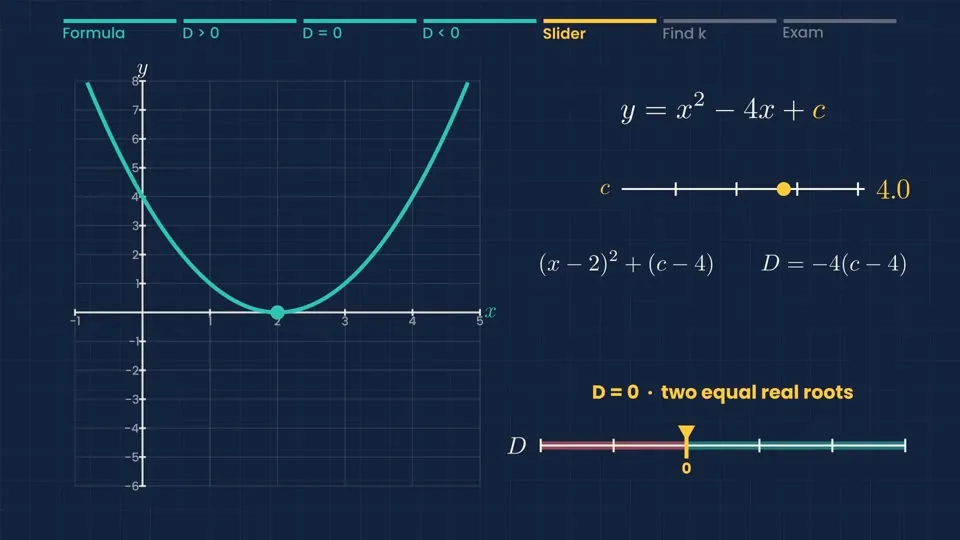
What the graph is doing. Take and move with a slider. Changing lifts or lowers the whole parabola, and . When the lowest point is under the axis, and the curve cuts the axis twice. Raise to 4 and the vertex rests on the axis, . Push past 4 and the curve floats clear, . The sign of answers one question: is the vertex below, on, or above the -axis? A larger positive also means the two roots are further apart.
Turning it round. Exam questions often give you the case and ask for a constant. For to have equal roots, set , so or ; both are valid. "Real roots" includes equal ones, so it means : for that gives , with so that the equation stays quadratic.
A downward-opening parabola follows the same rule. has and two real roots, and . When a question asks for the nature of the roots, it wants the kind of roots, not their values: find , then state the case in the book's words.
Key formulas
teal what we're studying · yellow what's changing · coral a common slip
Common mistake
Squaring a negative and keeping the minus sign. If , then , so is wrong: write the brackets every time.
The other slip is reading , and before the equation is in standard form. For , first move everything to one side, , and only then read , , giving .
Exam lens
Is it possible to design a rectangular garden with perimeter 40 m and area 120 m²? If so, find its length and breadth.
Length + breadth = 20 m, so take the length as and the breadth as .
Here , , , so
is negative, so the equation has no real roots. Such a garden is not possible.
(With area 100 m² instead, and the only garden is a 10 m × 10 m square, the largest area a 40 m fence can enclose.)