The idea
A pattern that keeps going. Start with 1. Add 3 and the total is 4. Add 5 and it becomes 9; add 7 and it reaches 16. Each of those totals is a square number: 1 × 1, 2 × 2, 3 × 3 and 4 × 4. Add the next odd number, 9, and you get 25, which is 5 × 5. Luck, or a rule?
Odd numbers as L shapes. A square number is a count of dots that you can lay out as a square: 9 dots fill 3 rows of 3, and 16 dots fill 4 rows of 4. Odd numbers have a shape too. Bend one into an L whose two arms are the same length, with a single dot at the corner. Seven, for example, is a corner dot with three dots on each arm. That lonely corner dot is what makes a number odd. Eight dots pair off neatly into two rows of four, but nine dots always leave one dot with no partner.
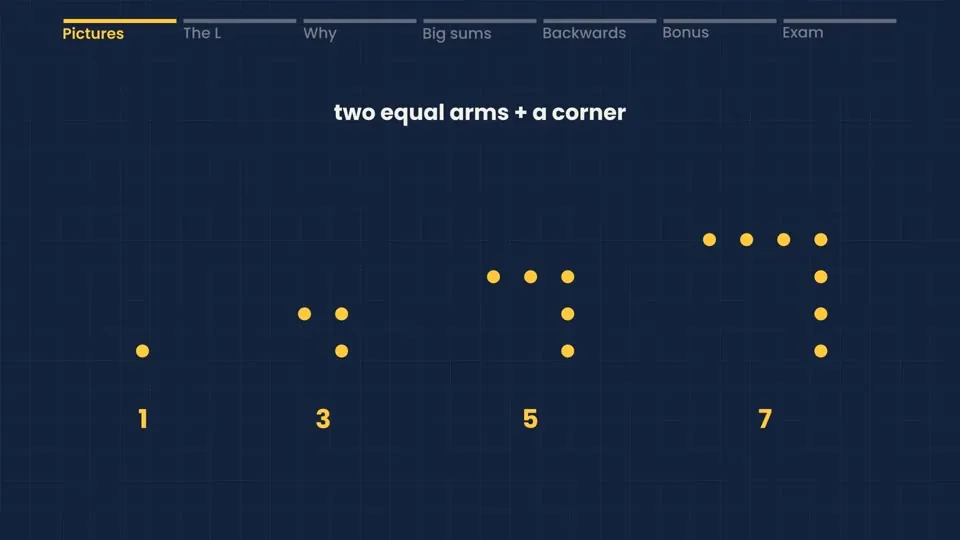
The L wraps the square. Lay out a 3 by 3 square. To turn it into a 4 by 4 square you need a column of 3 down one side, a row of 3 along the top, and one dot to fill the gap where they meet. That is 3 + 3 + 1 = 7, the next odd number. The same move works at every size: the L you add always has arms as long as the side of the old square. Growing a 6 by 6 square into a 7 by 7 one takes 6 + 6 + 1 = 13 dots, and 36 + 13 = 49. Growing 9 by 9 into 10 by 10 takes 19 dots, and 81 + 19 = 100.
Why it can never fail. Begin with a single dot and wrap on L after L: 3, then 5, 7, 9, 11 and 13. Each L is the next odd number, and each one completes a bigger square. After seven odd numbers you are holding a 7 by 7 square of 49 dots. Read the picture in reverse and any square comes apart into nested Ls: a 4 by 4 square peels into 1, 3, 5 and 7. So the rule is short. Count how many odd numbers you added, then multiply that count by itself.
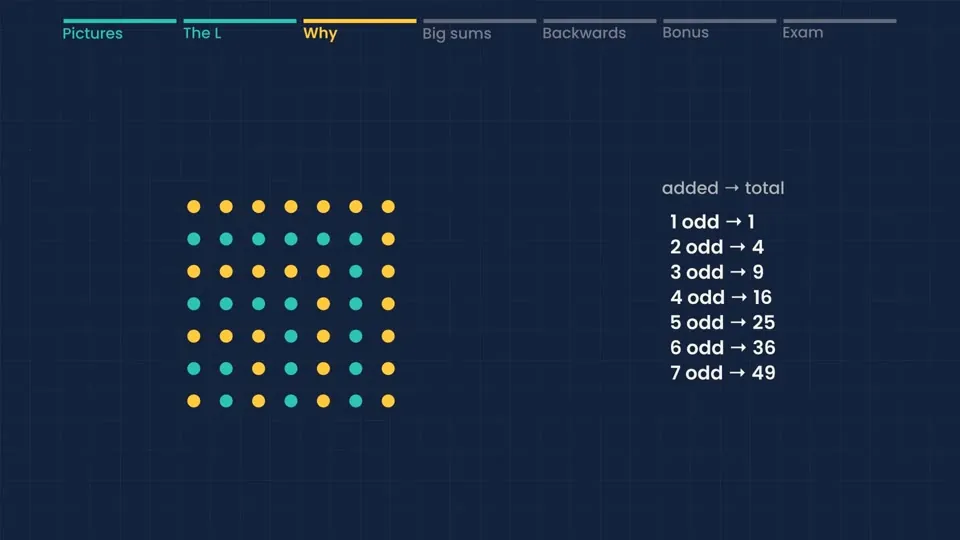
Big sums without adding. The first ten odd numbers go from 1 to 19, so they total 10 × 10 = 100. The first hundred odd numbers total 100 × 100 = 10,000. A second method agrees: pair 1 with 19, 3 with 17, 5 with 15 and so on. Every pair makes 20, and five pairs make 100. Notice also that the tenth odd number is 19, one less than twice ten, and the hundredth is 199.
Working backwards. Some questions give you the last odd number rather than the count. Add one to it and halve the result. For 1 + 3 + … + 29, that gives 30 ÷ 2 = 15 odd numbers, so the total is 15 × 15 = 225. The pattern also spots impossible questions: odd numbers added from 1 can never total 50, since 50 sits between the squares 49 and 64. And if the total is 144, which is 12 × 12, then twelve odd numbers were added and the last of them was 23.
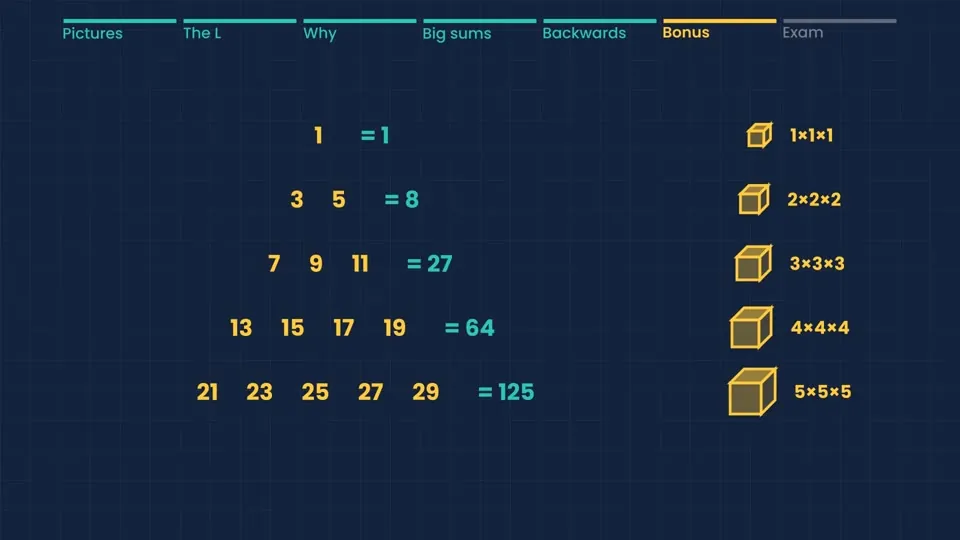
A bonus pattern. Write the odd numbers in rows holding one, two, three, four and five numbers, then add along each row. The totals are 1, 8, 27, 64 and 125, the cube numbers 1 × 1 × 1, 2 × 2 × 2, 3 × 3 × 3 and onwards. So odd numbers build cubes as well as squares.
Key formulas
teal what we're studying · yellow what's changing · coral a common slip
Common mistake
To grow a 3 by 3 square into a 4 by 4 square, it is tempting to add just one more column: . But 12 dots make a 3 by 4 rectangle, not a square.
A square has to grow in both directions at once, so you need a new row, a new column and the corner dot: , and .
Exam lens
Without adding, find 1 + 3 + 5 + … + 49.
First count the odd numbers. Add one to the last number and halve it:
So there are 25 odd numbers, and their sum is 25 times 25:
Write the count first, then the square: "25 odd numbers, so the sum is 25 squared." The sum is 625.
(Quick-fire: to go from 64, which is 8 by 8, to the next square, add an L with arms of 8: , and , which is 9 by 9.)