Ch 1 Orienting Yourself: The Use of Coordinates
Films in this chapter
-
 8:19
Concept film
Cartesian Plane, Visually
- Coming soon Concept film Distance and Midpoint Formula, Visually
- Coming soon One shot Coordinate Geometry One Shot
In this chapter
This is the first chapter of Ganita Manjari Part I for Class 9, and it is about describing exactly where something is using numbers. It opens with a short history: grid-planned city streets, latitude and longitude, and Brahmagupta's treatment of zero and negative numbers, without which a plane with four quadrants could not exist. The book then notes the work of Fermat in 1636 and Descartes in 1637, which showed that two numbers are enough to fix any point in a flat plane.
Next comes a story. Reiaan has just moved to a new city, and his sister Shalini builds a pin-and-thread model of his room so that he can feel where the door, the furniture and the walls are. The room becomes the setting for many of the chapter's questions.
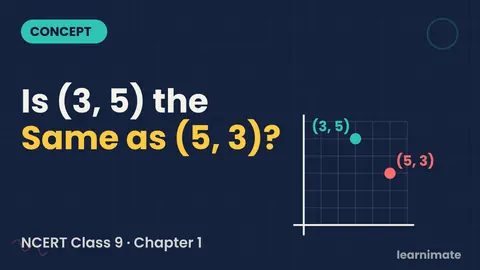
The main idea is the two-dimensional coordinate system. Two number lines meet at right angles at the origin, : the horizontal one is the -axis and the vertical one is the -axis. Each point gets an -coordinate and a -coordinate, written in that order, and swapping them gives a different point unless the two numbers are equal. The axes split the plane into four quadrants, and the signs of the coordinates tell you which one a point is in. Points with a zero coordinate lie on an axis. Lengths of segments parallel to an axis come from simple subtraction, giving the sizes of doors, tables and rooms.
The chapter ends with the distance between any two points, found with the Baudhāyana–Pythagoras theorem, and a look at how reflecting a shape in an axis keeps its side lengths the same.
The concept film here covers the plane itself: the axes, order, quadrants, points on the axes, and measuring shapes from coordinates.