The idea
Picture a delivery rider told to find "the blue door near the park" in a city with three parks and many blue doors. Now send the message "Avenue 3, Street 5" instead, and the rider rides straight there. Two numbers beat a whole description. But is Avenue 3, Street 5 the same place as Avenue 5, Street 3? No. The numbers are the same, the houses are not, because the order matters.
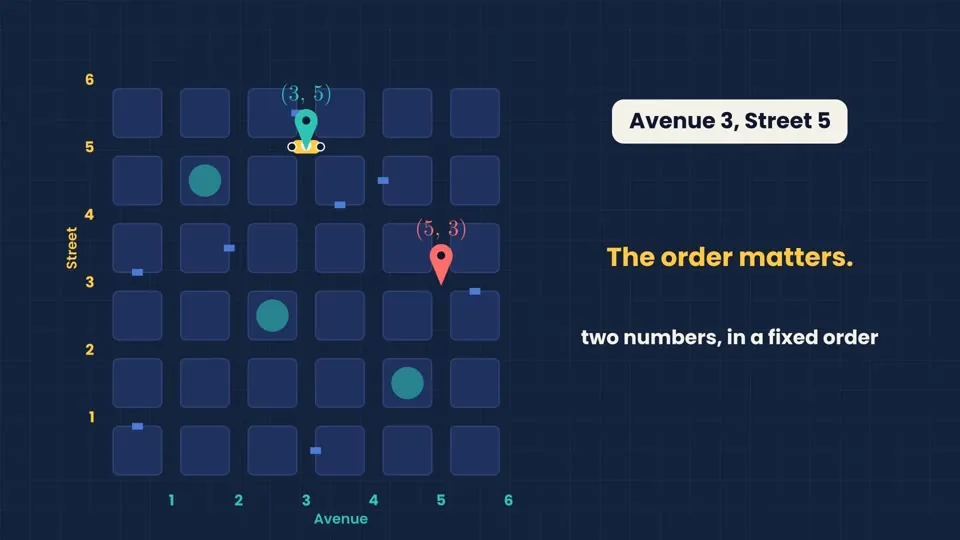
Why one number is not enough. On a number line, a single number fixes a position: 3 is three steps right of zero, and is two steps left. A page or a playing field is flat, though, so a point can be to the right and also some way up. To capture both, stand a second number line upright through the zero of the first, at a right angle. The horizontal line is the -axis, the vertical one is the -axis, and they cross at the origin, . The flat surface they sit on is the Cartesian plane. Cinema seats (row and seat number) and places on Earth (latitude and longitude) use the same two-number idea.
Across first, then up. To read a point, drop a line from it to the -axis and another across to the -axis. If they land on 4 and 3, the point is : its -coordinate is 4 and its -coordinate is 3. Think of it as directions from the origin: four steps right, then three steps up. Swap them to and you arrive somewhere else. (Older textbooks call the two numbers the abscissa and the ordinate.)
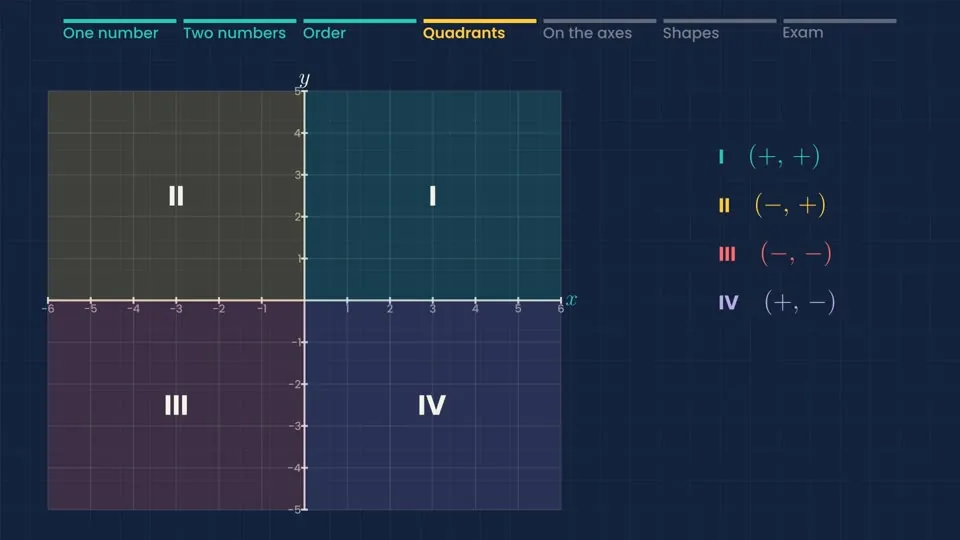
Four quadrants. The axes carry on past zero, with negative values to the left and below. Together they cut the plane into four quadrants, numbered I to IV anticlockwise from the top right. The signs tell you where you are: I is , II is , III is and IV is . So , three left and two up, is in quadrant II, and is in quadrant IV. A moving point changes quadrant exactly when one of its coordinates changes sign.
Points on the axes. If , as in , you never went up, so the point is on the -axis. If , as in , you never went across, so it is on the -axis. Such points belong to no quadrant; they sit on the borders. Only the origin lies on both axes.
Measuring without a ruler. Join , , and to get a rectangle. and share a -coordinate, so is horizontal and its length is the gap in : . and share an -coordinate, so . The area is square units and the perimeter is units. The gap still works across an axis: from to is units. The triangle with corners , and is half of a 4 by 3 rectangle, so its area is 6 square units.
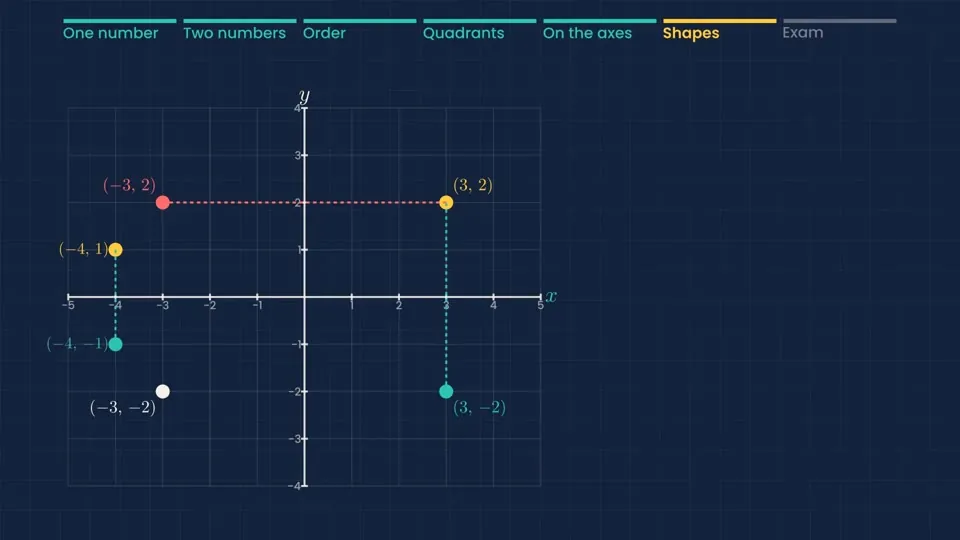
Mirrors in the axes. Reflect in the -axis and only changes sign, giving . Reflect it in the -axis and only changes sign, giving . Do both and you reach : four mirror images, one per quadrant, forming a rectangle centred on the origin.
Key formulas
teal what we're studying · yellow what's changing · coral a common slip
Common mistake
Swapping the order of the two numbers. The point is three across and four up, so writing it as names a different point: the -coordinate always comes first.
A related slip is putting on the -axis because the zero comes first. An -coordinate of zero means you never moved across, so is wrong: the point sits on the -axis, three units above the origin.
Exam lens
Write the quadrant or axis for each point: , , , .
Look at the signs of the two coordinates, first.
A zero coordinate puts a point on an axis, not in a quadrant. So: II, IV, the -axis (below the origin), III.