The idea
Try three puzzles. Two numbers add to and differ by : almost everyone answers and at once. Now two numbers add to , and twice one plus twice the other is . Finally, two numbers add to and also add to . The first puzzle has one answer, the second has endless answers, and the third has none. Straight lines explain all three.
One equation, a whole line. is satisfied by , , , and many more, including fractions like and negatives like . Plot them and they fall in a straight row; join them and every point of that line is a solution. A single equation in two unknowns never settles one answer. To draw a line quickly, find where it meets each axis: for , gives and gives , and a ruler through and finishes it.
Two lines, one meeting. Draw through , and . A solution of the pair must lie on both lines, so it is their crossing point, . Substitute it into both equations as a check: and . Lines that cross once give a unique solution, and the book calls such a pair consistent.
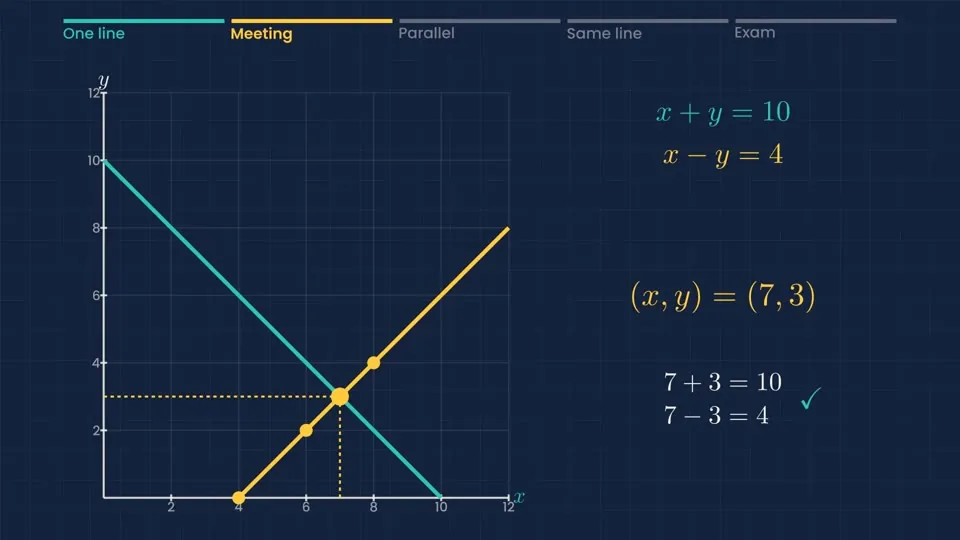
The limit of a picture. and also cross, but between gridlines, at . The graph tells you there is one solution and roughly where; algebra supplies the exact value.
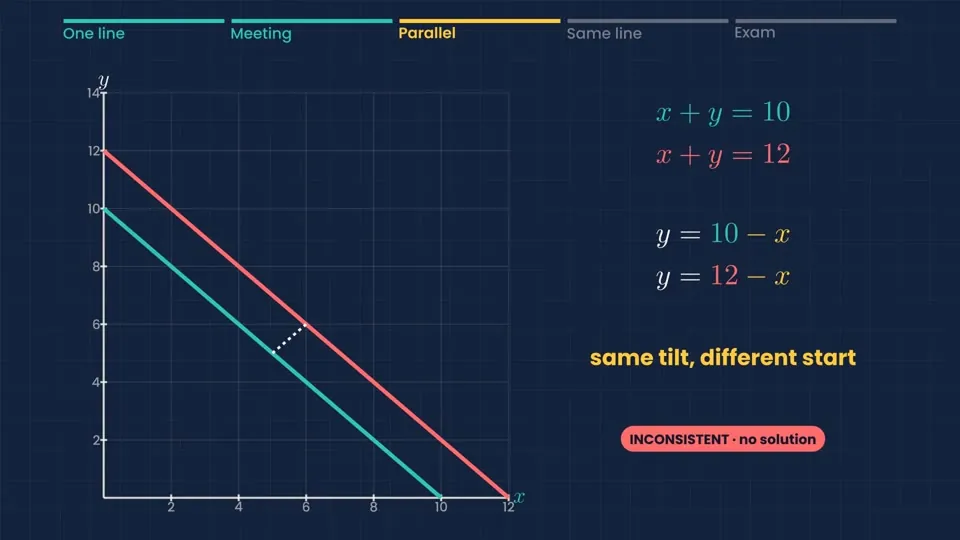
Parallel lines. and become and . Both fall by one unit for each unit to the right, so they share a tilt but start at different heights. They stay the same distance apart forever, so there is no solution and the pair is inconsistent.
One line drawn twice. Halve and you get again. The second line lies on top of the first, so every point, such as , satisfies both. The pair is dependent, and still consistent because solutions exist.
Ratios instead of drawing. Write each equation as and compare , and . If the first two differ, the lines cross once. If the first two agree but the third differs, they are parallel. If all three agree, it is one line. For and , , and indeed the lines meet at .
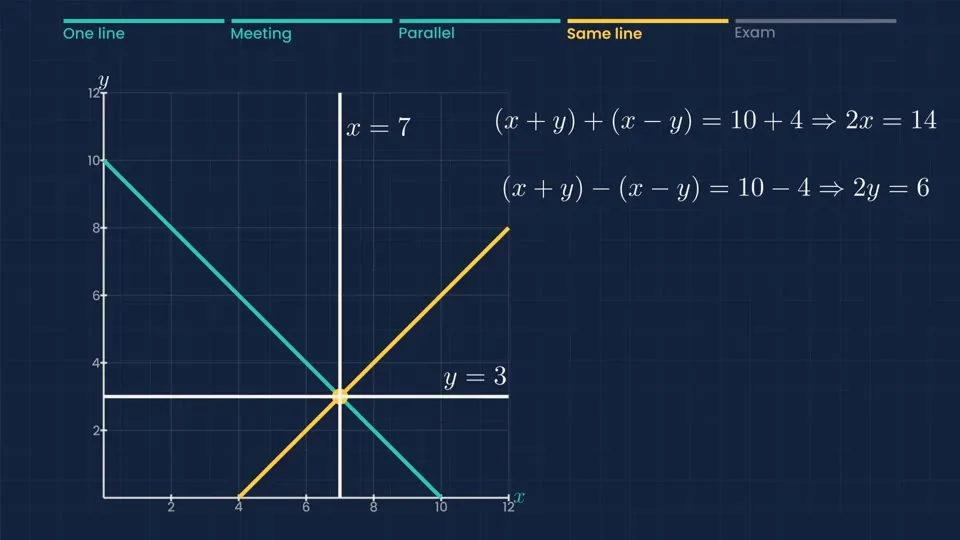
Elimination on the graph. Add and to get , the vertical line . Subtract them to get , the horizontal line . Both pass through : combining equations swaps the lines for simpler ones without moving the answer. Substitution is like sliding along one line until the other equation becomes true.
A word problem. A pen and a notebook cost ₹50 together, and the notebook costs ₹20 more. With and , adding gives , so the notebook is ₹35 and the pen ₹15, the point where the two lines cross.
Key formulas
teal what we're studying · yellow what's changing · coral a common slip
Common mistake
Assuming two equations in two unknowns \cor{always have exactly one answer}. They can have none, as with and , or infinitely many, as with and ; the picture of two lines shows which.
The other trap is trusting a graph reading as exact. and meet at , about , which no one can read off squared paper as \cor{}: use the graph for how many and roughly where, and algebra for the exact values.
Exam lens
For what value of do and have infinitely many solutions?
Infinitely many solutions means the two equations describe the same line, so all three ratios must be equal:
Both and equal , so
Check: with , the second equation is just the first one doubled. .