The idea
A question about buses. Two buses leave a depot together at 8:00. One runs every 12 minutes and the other every 18 minutes. They first leave together again at 8:36, and the quickest way to see why is to break each number into primes.
Primes as building blocks. Pick any number, say 360, and write it as two factors, such as . Split each factor again, and again, until no piece can be split further. The pieces left at the bottom of this factor tree are prime numbers, and they are the atoms the number is made from:
You can picture these primes stacked in towers, a kind of DNA for the number. Some numbers hide theirs well: 1001 looks close to prime, yet it is .
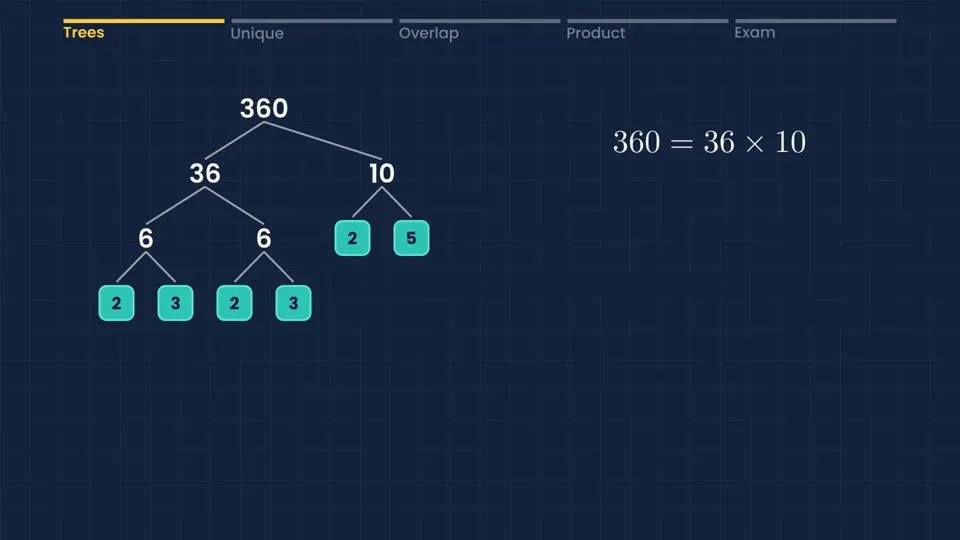
The same leaves every time. Now begin the tree for 360 differently, with . The branches look nothing like the first tree, yet the leaves are again three 2s, two 3s and a 5. However you grow the tree, only the order of the primes can change. That is the Fundamental Theorem of Arithmetic. It depends on 1 not being prime: if it were, 6 could be written as , , and so on without end.
HCF and LCM as a picture. Write and , and place their primes in two overlapping circles. The primes they have in common, one 2 and one 3, go in the overlap. Multiply those and you get the HCF, 6. Multiply everything in the diagram, two 2s and two 3s, and you get the LCM, 36: the minute the buses meet again, after three trips of one and two of the other. In short, the HCF takes each shared prime at its smaller power, and the LCM takes every prime at its larger power. If the overlap is empty, as for 8 and 15, the numbers are co-prime: HCF 1, LCM 120. Neighbouring numbers such as 14 and 15 are always co-prime, since anything dividing both would divide their difference of 1.
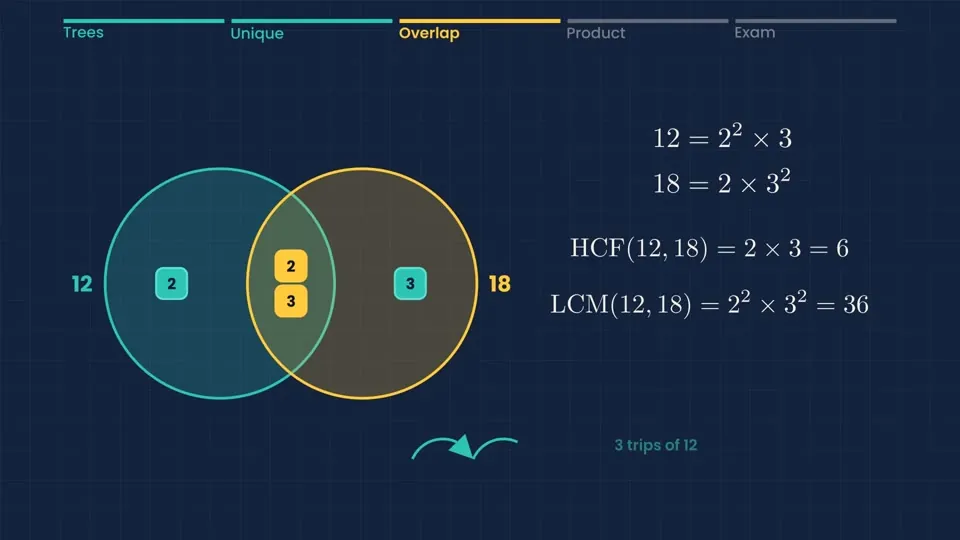
HCF × LCM. For 12 and 18, . The diagram explains it: each prime is counted once in the overlap and once in the whole, just as it appears once in each circle. Hence, for every pair of positive whole numbers, multiplying the HCF by the LCM gives the product of the pair. With three numbers this shortcut fails, although the diagram still works: for 12, 18 and 30 the centre holds a 2 and a 3, so the HCF is 6, and the LCM is .
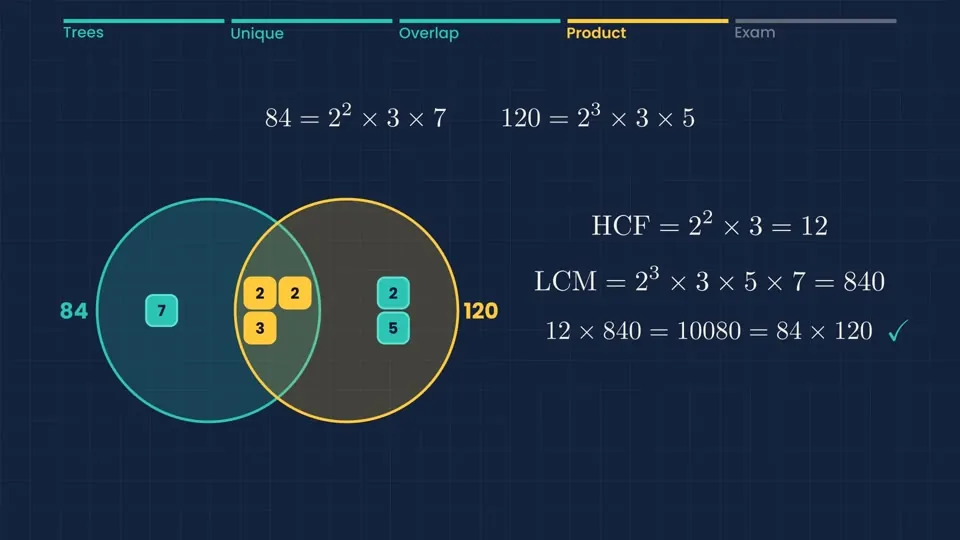
A larger pair. For 84 and 120 the overlap holds , so the HCF is 12, and the LCM is . Check: . The HCF tells you that square tiles of side 12 cm cover an 84 cm by 120 cm shelf exactly, 7 by 10, so 70 tiles. The LCM tells you two border patterns repeating every 84 cm and every 120 cm line up again at 840 cm.
Key formulas
teal what we're studying · yellow what's changing · coral a common slip
Common mistake
Taking the bigger power of a shared prime when finding the HCF. Since and , writing is wrong: 84 has only two 2s, and is not even a whole number. The HCF uses the smaller power, .
A second slip is using HCF × LCM = product for three numbers. For 6, 10 and 15 the HCF is 1 and the LCM is 30, but . The shortcut is for two numbers only.
Exam lens
Check whether can end with the digit 0 for any natural number .
A number ending in 0 is a multiple of 10, and , so its prime factorisation would have to contain the prime 5.
The only primes in are 2 and 3. By the Fundamental Theorem of Arithmetic this factorisation is unique, so no other factorisation can contain a 5.
So never ends with the digit 0, for any natural number .