The idea
So close, never exact. Try to find a fraction whose square is 2. The fraction is a strong attempt: its square is , while 2 equals . It misses by one part. A bigger try, , misses by one as well, this time from below, because . Could some fraction ever land exactly?
What irrational means. A rational number can be written as with whole numbers and , , and its decimal either ends or repeats. The decimal of begins , but no list of digits, however long, can rule out a repeat later on. Fractions are also crowded together: between and sits , and between any two there is always another. Still avoids them all. To show that for certain, assume it is a fraction in lowest terms and look for trouble. Squaring and clearing the denominator gives .
Two squares inside one. Read as areas: one square of side has the same area as two squares of side . Push the two smaller squares into opposite corners of the big one. Since , they cannot sit side by side, so they overlap in the middle and leave two small corners bare. The overlap is covered twice and the corners not at all, so for the totals to match, the middle square must equal the two corners together:
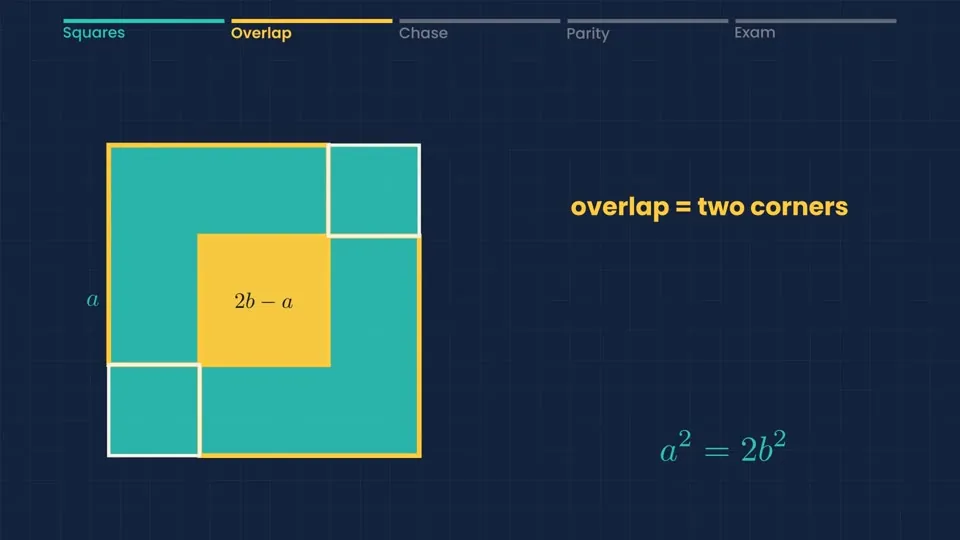
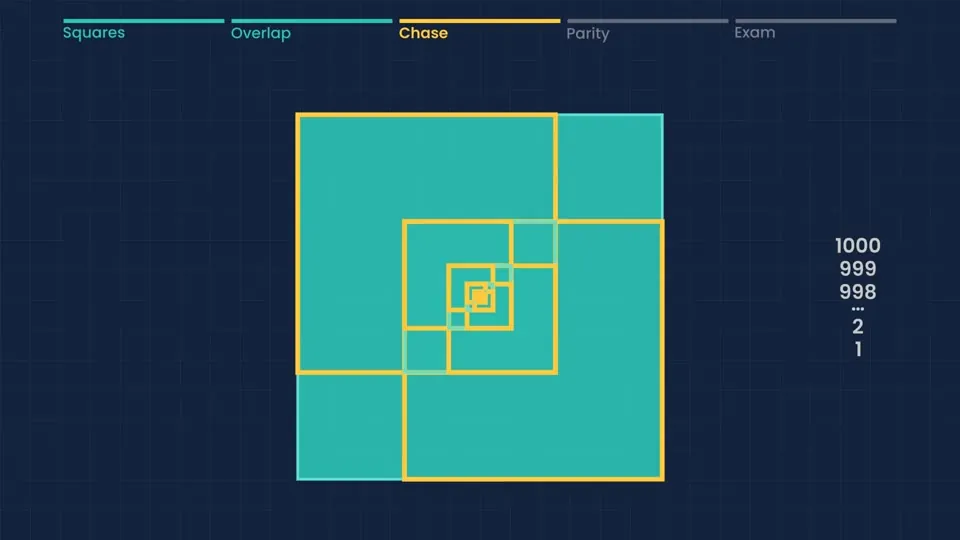
A chase with no end. That is the original picture again, one square equal to two, so is another fraction for , built from smaller whole numbers. That clashes with being in lowest terms. Worse, the step could be repeated for ever, but positive whole numbers cannot keep shrinking: count down from 1000 and you reach the bottom in at most 1000 steps. The assumption must be false, so is irrational. This style of argument is called proof by contradiction. Applied to the near misses, the same step takes to , , , and , each still missing by exactly one.
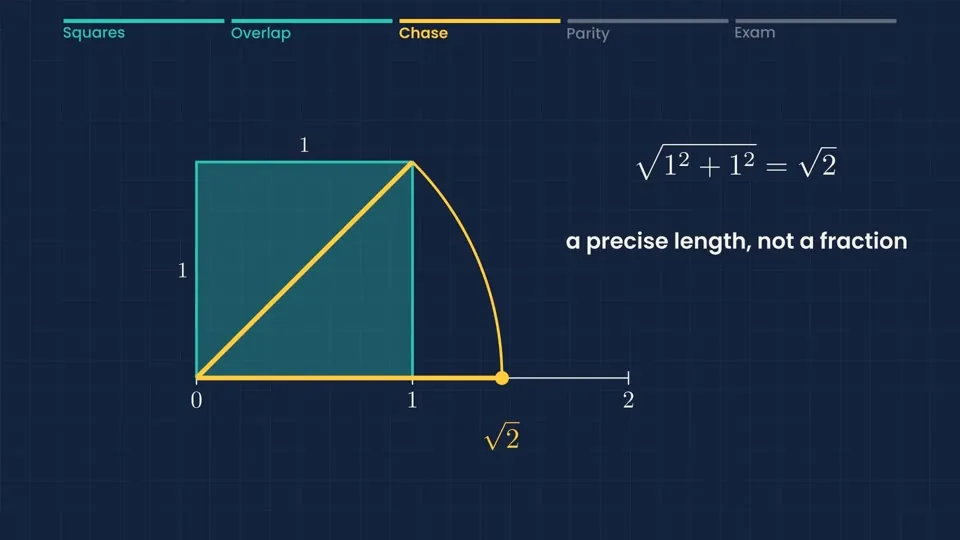
Irrational, yet exact. The diagonal of a square with side 1 is exactly by Pythagoras. Swing it onto the number line with a compass and it marks a definite point a little past 1.4. It is a precise length; it just is not a ratio of whole numbers.
The proof in the textbook. NCERT starts from the same equation, , so is even. An odd number squared is odd, so itself is even. In prime terms, squaring doubles every prime power, so any prime in was already in . Put : then , giving , so is even too. Both even contradicts lowest terms. For , the same steps with the prime 3 show that 3 divides both and . The argument relies on the prime: it works for , and the root of any prime.
Key formulas
teal what we're studying · yellow what's changing · coral a common slip
Common mistake
Believing that two irrational numbers always add up to an irrational number. They can cancel: , and 0 is rational. Products can do it too, since . What is always true is that a rational number plus an irrational number is irrational.
The other trap is running the proof on . The step " divides , so divides " fails ( divides but not ), because that step needs a prime. And is rational anyway.
Exam lens
Prove that is irrational.
Suppose, for contradiction, that is rational. Call it , a rational number.
Since 5 and are rational, is rational, so would be rational. But is irrational, which is a contradiction.
So our assumption was wrong, and is irrational.