The idea
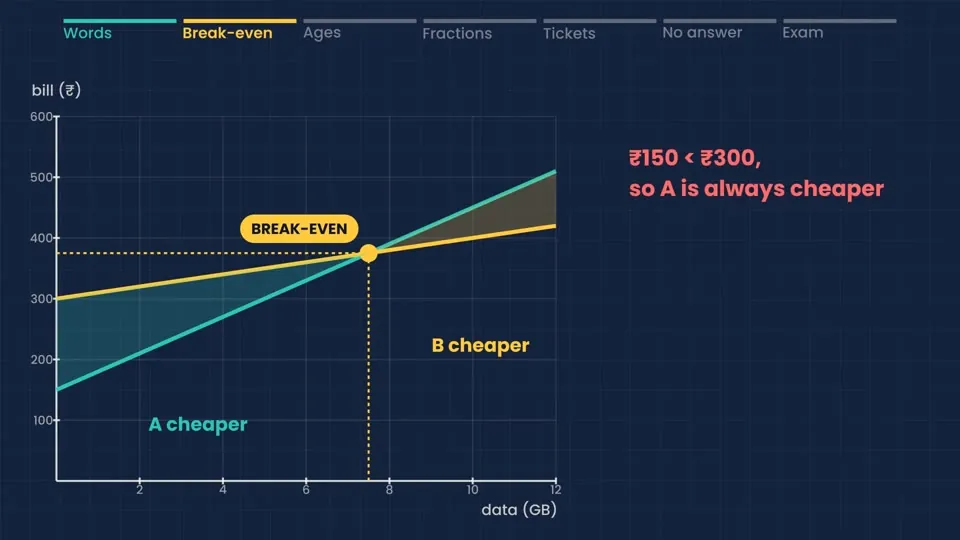
Picture two mobile plans. Plan A charges ₹150 a month and ₹30 for each gigabyte; Plan B charges ₹300 a month but only ₹10 per gigabyte. With 2 GB of data, A costs ₹210 and B costs ₹320, so A looks like the obvious choice. At 10 GB the order flips: A comes to ₹450 and B to ₹400. Somewhere between those two amounts the cheaper plan changes, and a pair of linear equations finds the exact spot.
From sentences to equations. First give the unknowns names: let be the gigabytes used and the monthly bill in rupees. A fixed monthly fee is a constant, and a charge per gigabyte is that rate times . That turns the adverts into and . Either equation alone has endless solutions, one bill for every possible amount of data; the second fact is what narrows things to a single pair. On a graph, the fixed fee is where each line meets the cost axis and the rate is its steepness. Plan A starts lower but rises three times as fast.
The break-even point. A line that begins lower and climbs faster has to overtake the other one. Setting the bills equal, , leaves , so , and both bills are then ₹375. Below 7.5 GB Plan A's line sits lower, so A is cheaper; above it, B wins. The algebra delivers one number, while the graph shows what happens on either side of it.
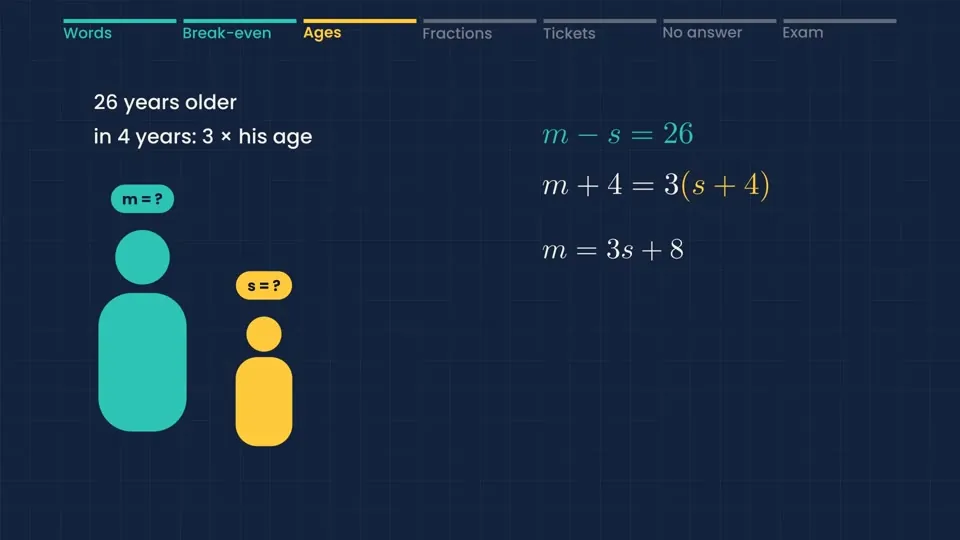
Ages. A mother is 26 years older than her son, and in four years she will be three times his age. With and for their ages now, the facts read and . The second simplifies to ; putting that into the first gives , so the son is 9 and the mother 35. A check against the words: in four years they are 13 and 39, and 39 is three times 13.
A hidden fraction. If adding 1 to the top and bottom of gives , and adding 5 to both gives , cross-multiplying produces and . Substituting gives , : the fraction is , and indeed and .
Tickets and a boat. A play sells 300 tickets, adults at ₹50 and students at ₹20, taking ₹9,000 in all. Replacing with gives : 100 adults and 200 students. A boat covering 30 km upstream in 3 hours and the same distance downstream in 2 has and . Adding the two equations gives , so the boat moves at 12.5 km/h in still water and the stream at 2.5 km/h.
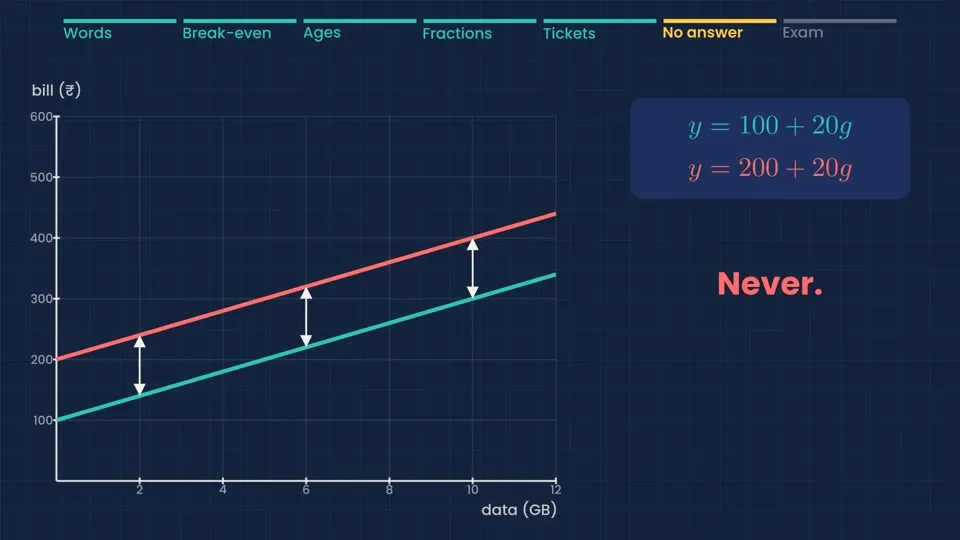
When there is no single answer. Two plans with the same ₹20 rate but fees of ₹100 and ₹200 give parallel lines, always ₹100 apart, so there is no solution. Two adverts that describe the same bill in different words, such as ₹20 per GB versus ₹10 per half GB, give one line drawn twice, with infinitely many solutions.
Every problem above follows four steps: name the unknowns, write one equation per fact, solve by substitution or elimination, then test the answer against the original sentences, keeping the units consistent throughout.
Key formulas
teal what we're studying · yellow what's changing · coral a common slip
Common mistake
Judging two plans by their fixed charges alone: , "so Plan A is always cheaper". The fixed charge only sets where each line starts; the rate per gigabyte decides where it goes, and beyond 7.5 GB Plan B is the cheaper one.
In the age problem, writing forgets that the son also gets four years older. The brackets in carry that meaning; without them you get a son of 13 today, a tidy but wrong answer.
Exam lens
3 pens and 2 notebooks cost ₹110. 6 pens and 4 notebooks cost ₹220. Find the price of each.
Let one pen cost ₹ and one notebook ₹. The two statements give
Compare the ratios of the coefficients and the constants:
All three ratios are equal, so the second equation is just the first one doubled. Both describe the same line, and every point on it is a solution.
The pair has infinitely many solutions, so the price of each item cannot be found from this information.
(Quick-fire: a boat goes 24 km upstream in 4 h and 24 km downstream in 3 h. Then and ; subtracting gives , so the stream flows at 1 km/h.)